Sergei Eisenstein, 1946
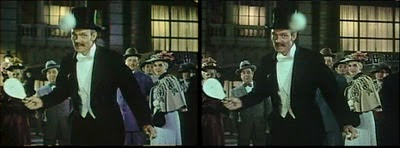 |
| House of Wax (1953) |
A current trend is advertisement of 3-D stereoscopic movies billed as 'Shot in 3-D' and billed as 'Also available in 2-D', besides 2-D films now being called 'in 2-D with normal ticket prices'. This is a worrying development but historically speaking a predictable one. Everybody knows there have been two major 3-D film bubbles in the past; in 1953/54 and in 1983/84, but not many people actually know why these 3-D bubbles burst and did not herald the era of 3-D film making. What makes it difficult to compare the historic bubbles is the wildly different technical abilities of the different years, the difference in marketing, in targeting and in public spending power. There has also been a feature film production and theatre runtime inflation: in the 1950's many fewer films were produced overall and they were playing in cinemas for a longer period of time as well.
 |
| Taza, Son of Conchise (1954) |
An updated version of the 3-D Filmography - the biggest and most accurate 3-D stereoscopic film list published anywhere - means a great chance to update the statistics. After updating the 3-D filmography Gary Palmer, writer and editor of the list, made a very interesting remark about James Cameron's latest press statement which gave me the idea for combining the list, the statistics and the knowledge to come to a coherent image of what is going on with 3-D film and what may happen with it next. What Gary pointed at was James Cameron saying he wanted the 3-D in Avatar - and in his future 3-D and 4-D films - to be unobtrusive and so much so that people will forget they are watching a 3-D film altogether (a bit hard with 4-D films, but there you go). So then what is the point?
When you pay a premium ticket price for a 3-D showing, you want to see 3-D and be reminded you are watching 3-D; I can't tell you how often I have heard people say they like this or that 3-D film, but were disappointed with the 3-D because it was too flat or 'was never used': coming out of the screen in an obvious fashion. So that leaves us with the question: is today's 3-D content with its stereo window-inward quality really better than yesterday's 3-D that used much more of the negative parallax space and is this more subtle content the reason 3-D appears to have more staying power this time around?
 |
| Monsters VS Aliens (2009) |
There is a lot of PR wah-wah about why today's 3-D is so much better than that of the 1950's or 1980's, but of course the complete truth is never spoken. It would be too uncomfortable to discuss technologically sound 3-D projection in the 1980's or more grown up 3-D film content in the 1950's and so journalists keep on copy-pasting the original blurb put out by Real-D and James Cameron 3 years ago. Shame on the critic who claims 'Piranha 3D' or 'My Bloody Valentine 3D' are better technically or creatively than 'House of Wax' or 'Dial M for Murder'!
 |
| Polarized projection: from 1952 onward |
3-D Price Premium
There was mostly no ticket price premium for 3-D films in 1953 and 1983 and thus the studios had to carry the extra cost of their 3-D productions. When attendance numbers went down, the 3-D revolution was over as quickly as it started in those two occasions. Today, studios and distributors have merged, own the multiplexes in which their films are shown and have a strong presence in the TV and DVD side of distribution. Because of this, the 3-D premium at the box office and the 3-D BluRay price premium is keeping today's 3-D revolution alive and well. If 3-D ticket prices are forced down by lower attendance, 3-D movie production will be heavily reduced, or, more likely, the premium price for 3-D film viewing will become the standard for 2-D film attendance as well - a scenario where 3-D film production will go down as well because 2-D film will always remain cheaper to produce.
There may well be another reason for today's film studios' push for 3-D: it moves the bulk spending from post production back to the principal photography - back to the studios. This is, because once shot or rendered, 3-D film can barely be 'fixed' in post - only very minimally so - before heavy distortion of the image occurs. So the power is back in the hands of the DOP and camera makers.
 |
| 3-D Filming in 1983 using the Arri 3-D lens adapter |
3-D Film Favourites: Horror, thriller and Western
Not many people realize this, but in 1953/54 most 3-D films released were dramas and Westerns (30%). This number was closely followed by action and western movies (20%) and horror and thriller movies (17%). As the 3-D bubble collapsed in 1954, the same amount of 3-D movies as planned during the current stereoscopic craze were cancelled in 3-D and shot in 2-D. In most cases, CinemaScope had little to do with this as these films were pretty much all still released in 1.85 format. The real interesting question lies with the kinds of movies released in 3-D in this era and whether they were suitable for the 3-D process - and thus whether this might have had anything to do with the collapse of 3-D film in 1955. I just don't buy the argument that it was purely technical issues with 35mm film projector synchronizing, alignment (weave) and the cardboard polarizing glasses. This argument falls apart when the 1983/84 3-D boom is considered with its single lens / single film strip polarized colour film projection.
 |
| Polarized 3-D projection before Digital Cinema |
In the current 4-year 3-D film release growth of 2008-2012 the emphasis of type of film lies heavily on animation (38%), followed by horror / thriller (22%) and sci-fi / fantasy (17%). Of course the high numbers for animation have a lot to do with the current lower age and family-oriented target for film releases and the fact that CGI animation production finds a natural form in stereoscopic 3-D presentation - the step to go 3-D is relatively speaking most easy with CGI animation production. In this way, animation has actually been a large driving force for the current 3-D cinema release trend, but the number of animation film releases in 3-D cannot, realistically, be put against other historic numbers, as animation production is completely different from what it was 30 and 60 years ago. What is a real historic benchmark are the horror / thriller and sci-fi / fantasy film numbers (one can call sci-fi / fantasy the present day Western and romance / comedy has been moved into animation). In these numbers there is a visible shift from horror / thriller to sci-fi / fantasy as the 3-D boom continues into 2012 - a shift to a much larger family audience (more movie tickets and 3-D BluRays to be sold) and a shift away from cheap thrills, towards grand spectacle. However, grown up drama, war, documentary and comedy are still not in the 3-Dimensional picture and film makers continue the hundred-year trend of not taking 3-D film serious when it comes to content.
A note on 2-D to 3-D converted titles then: this is a practice impossible in the 1950's and 1980's. 16-26% of the 3-D releases of the years 2009-2012 are dimensionalized 2-D to 3-D conversions and although they wouldn't have existed as 3-D films before 2006 (Nightmare before Christmas), they are in the end still 3-D film releases. Quality of the 3-D is not debated here.
 |
| The Nightmare Before Christmas (2006) |
Scheduled 3-D stereoscopic feature film releases:
1953:
45 titles released (Total of 1,845, of which 2.5% in 3-D)
16 titles announced but not released in 3-D
Animation: 0
Horror / Thriller: 6
Action / Western action: 8
Documentary: 2
Sci-Fi / Fantasy: 2
Music/Dance: 4
Drama / Western drama: 16
War: 1
Adult: 1
RomCom: 5
1954:
19 titles released
24 titles announced but not released in 3-D
Animation: 0
Horror / Thriller: 5
Action / Western action: 5
IMAX / Docu: 0
Sci-Fi / Fantasy: 2
Music/Dance: 1
Drama / Western drama: 3
War: 0
Adult: 0
RomCom: 3
1983:
17 titles released (Total of 3,122, of which 0.5% in 3-D)
4 titles announced but not released in 3-D
Animation: 0
Horror / Thriller: 4
Action / Adventure: 3
IMAX / Docu: 0
Sci-Fi / Fantasy: 4
Music/Dance: 0
Drama: 2
War: 0
Adult: 3
RomCom: 1
1984:
7 titles released
1 titles announced but not released in 3-D
Animation: 0
Horror / Thriller: 2
Action / Adventure: 0
IMAX / Docu: 0
Sci-Fi / Fantasy: 2
Music/Dance: 0
Drama: 0
War: 0
Adult: 2
RomCom: 1
2008:
9 titles
Animation: 2
Horror / Thriller: 2
Action: 0
IMAX / Docu: 0
Sci-Fi / Fantasy: 1
Music/Dance: 1
Drama: 2
War: 0
Adult: 1
RomCom: 0
2009:
37 titles (21 minus animation) (Total of 6,522, of which 0.5% in 3-D)
Dimensionalized: 6
Animation: 15
Horror / Thriller: 8
Action: 1
IMAX / Docu: 3
Sci-Fi / Fantasy: 4
Music/Dance: 3
Drama: 0
War: 0
Adult: 3
RomCom: 0
2010:
77 titles (48 minus animation) (Total of 7,735, of which 1% in 3-D)
Dimensionalized: 20
Animation: 29
Horror / Thriller: 22
Action: 3
IMAX / Docu: 3
Sci-Fi / Fantasy: 11
Music/Dance: 5
Drama: 1
War: 0
Adult: 3
RomCom: 0
2011:
43 titles (28 minus animation) (Total of 3,933, of which 1% in 3-D)
Dimensionalized: 8
Animation: 15
Horror / Thriller: 6
Action: 5
IMAX / Docu: 1
Sci-Fi / Fantasy: 12
Music/Dance: 0
Drama: 4
War: 0
Adult: 0
RomCom: 0
2012:
6 titles (3 minus animation) (Total of 1,436, of which 0.5% in 3-D)
Dimensionalized: 0
Animation: 3
Horror / Thriller: 0
Action: 1
IMAX / Docu: 0
Sci-Fi / Fantasy: 1
Music/Dance: 0
Drama: 0
War: 1
Adult: 0
RomCom: 0

So can we draw conclusions from these numbers? One can say something about types of film and suitability for the 3-D process but a better perspective is gained when 2-D film genre releases are set against the 3-D numbers. The numbers appear to be roughly equal in percentages, so one can state that 3-D film release mirror 2-D film releases for genre, or that most 3-D film producers decide to 'go 3-D' mid-production of a 2-D film.
In absolute numbers, the number of 3-D releases has jumped up from 0.5% to 1% (no 3-D revolution yet) and when animation and 3-D conversion titles are subtracted from the present day totals, the number of 3-D feature films released in 1953 is still more than double that of today's 3-D resurgence on a year-by-year basis. Does that really matter though if today's 3-D boom is a continuous one? The infrastructure for incidental 3-D film release is now in place and unless all the Real-D, Dolby3D and Xpand projector adapters are all on hire or on short-term maintenance contracts, releasing a film, or parts of it, in 3-D will remain a real option for future film producers.
Alexander Lentjes is available as Consultant or Production member for your 3-D Stereoscopic animation or live-action television or feature film production. More information and Contact details at www.the3drevolution.com/contact.html


